

 LinkedIn
One ChatGPT answer names your business. The next leaves you out. Neither answer, on its own, tells you whether buyers can find you. In a test of 2,961 prompts across ChatGPT, Claude and Google AI Overviews, researchers found less than a 1-in-100 chance of getting the same brand list twice.
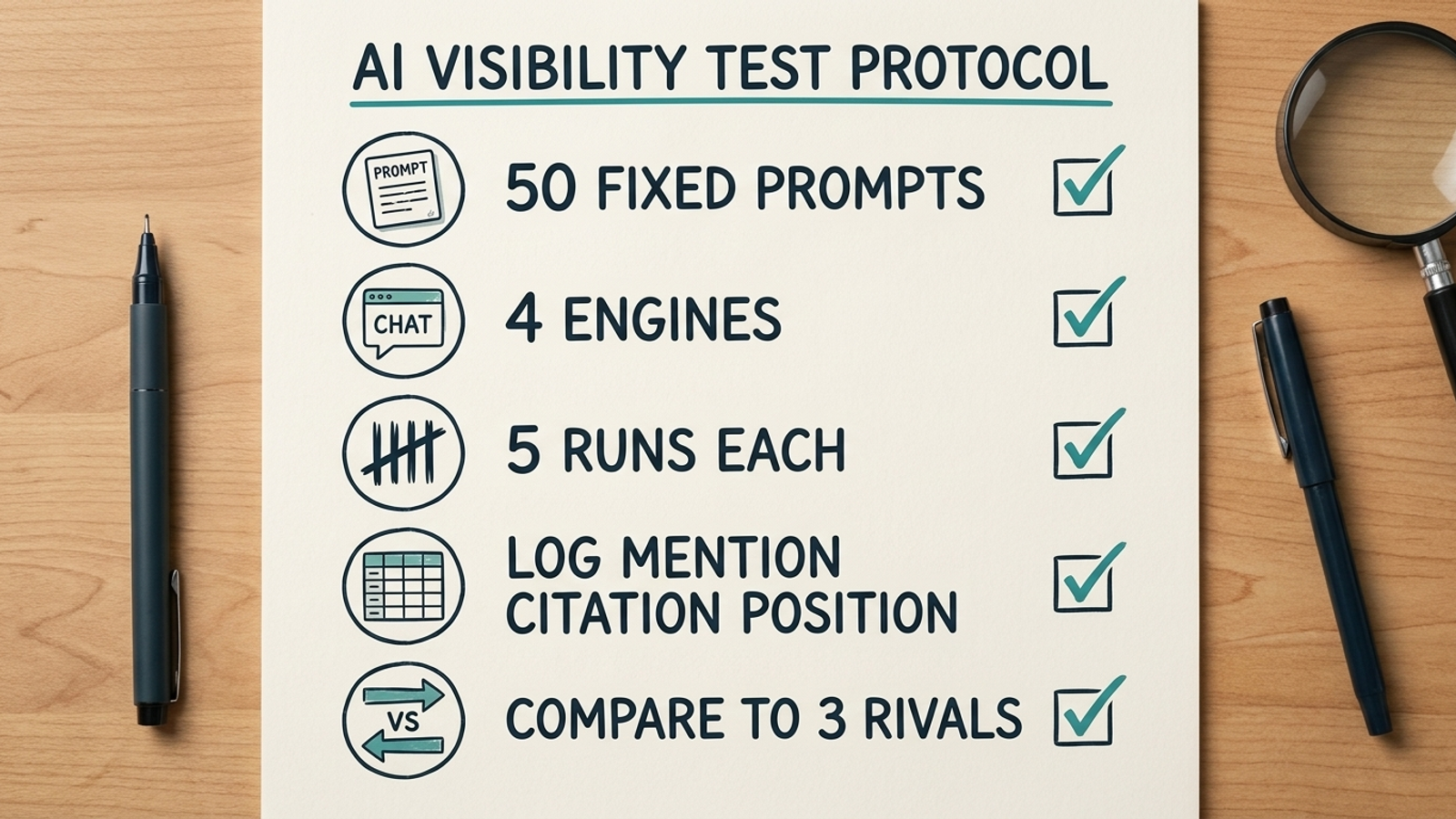
I treat AI visibility the way I treat ad copy: fix the inputs, repeat the test, and compare the result with a control group. Here is the protocol I would run before paying for a tracking tool: 50 buyer prompts, five runs per prompt on each of four engines, three named competitors, and a threshold for deciding what deserves action. The point is not to manufacture an AI visibility score. It is to find which questions reliably bring up your business and which ones send buyers elsewhere.
Question: Which buyer prompts bring up your business?
Forget “are we mentioned in AI?” That question is too broad to act on. Ask instead: when a buyer describes a need in their own words, does the answer name your business, link to your site, or recommend hiring you? Those are different events. A mention names you anywhere; a citation links to your URL as a source; a recommendation suggests you as an option to buy from or hire. Record each separately. A name in a list is not the same as a linked source, and neither guarantees a recommendation.
Build the test from sales calls, quote forms and Search Console queries, not your homepage headline. A buyer might type “best garage door repair for rental properties in Austin” or “my AC blows warm air, what do I check first.” Those prompts expose different needs. If you test only the polished language your marketing team uses, you will learn how an engine handles your marketing copy. That is not the question buyers are asking.
My expectation is that a minority of prompts will account for most mentions. I would put that hypothesis at 10 to 15 of the 50 prompts driving about 80% of them. Treat that as a prediction to test, not a result to assume. The useful output is the list of prompts, not whether my guess survives.
Why repeat an identical prompt five times?
A single answer can look decisive while being a one-off. A controlled study of 10 best-X-for-small-business questions, run three times each on ChatGPT and Gemini, found mean pairwise overlap of 69.5% in the recommended businesses. Gemini’s overlap was 51.9%; ChatGPT’s was 87.2%. The study also found that 27% of business slots appeared only once. If your business lands in that volatile tail, a screenshot makes you look visible right up until the next run leaves you out.
These systems do not all assemble answers the same way. They can draw on pretraining and live retrieval through different pipelines. Perplexity shows footnoted citations by default, which makes its cited sources easier to inspect. Google AI Overviews and ChatGPT can give you different answers to the same buyer question. That is why I would test more than one engine and keep their results separate.
My paid-search rule applies: one impression is noise; five is the start of a pattern. Some practitioners suggest two runs for important prompts. I use five because it gives a small business a workable distinction between appearing consistently, appearing intermittently and barely appearing at all. It is a decision rule, not a claim that five runs settle the question forever.
Setup: Freeze 50 prompts before opening a chat
Write all 50 prompts first. Use the wording a customer might type or say, then leave it alone for the full round. I would divide the list this way:
- 15 category prompts: “best X for Y” questions that ask for options.
- 15 problem prompts: questions such as “how do I fix Z?” that start with the need rather than a product category.
- 10 comparison prompts: your business versus a competitor, or alternatives to an option the buyer already knows.
- 5 brand prompts: questions such as “what is [your business]?” and “is [your business] legit?”
- 5 local prompts: questions with a city or “near me” attached, where location matters to the buyer.
That mix covers category, problem, comparison and brand language buyers use, with room for local intent. Replace the examples with language from your own sales conversations and query data. Do not change a prompt halfway through because you dislike its first answer; then you are testing a different question.
Keep the same list next month. Otherwise, a change in mention rate could come from your rewritten prompts rather than a change in the answers. If you discover an important new buyer question, save it for the next fixed list and note the change. The prompt set is your test instrument. Make it sound like buyers, then stop adjusting it while you measure.
Choose four surfaces and keep sessions clean
Run each prompt in ChatGPT, Gemini, Perplexity and Google AI Overviews. Start a fresh chat for each run where the interface allows it. Turn memory off and use a logged-out session where you can; a personalized conversation is a poor stand-in for a buyer encountering you cold. Record any setting you cannot keep consistent instead of pretending it was controlled.
I prioritize ChatGPT for volume, Perplexity for citation diagnostics and Google AI Overviews for reach. Run Gemini too. Do not pool the four into one number before looking at each separately: a prompt that names you repeatedly in Perplexity but not in Gemini tells a different story from one that names you everywhere.
Run five times per prompt per engine. The planned total is 50 prompts × five runs × four engines = 1,000 checks. Record when an AI Overview does not appear rather than treating a conventional Google result as an AI answer. The work sounds excessive until you compare it with making content decisions from one flattering response.
Name three competitors as controls
Choose three competitors you actually lose deals to. Use the names buyers mention, not aspirational brands added to make the spreadsheet look ambitious. Log whether each one appears on every run, alongside your own result.
Your mention rate needs that context. If an answer names you in two of five runs and a competitor in five of five, “we appeared” is technically true and strategically useless. The competitor comparison helps turn the sheet into a content roadmap; one way to summarize it is share of voice: your appearances against yours plus competitors’. Keep the individual rows, though. A single share-of-voice number will not tell you which buyer question to work on.
Measurements: Log the answer, not your impression of it
Create one row for each prompt-engine-run. The columns I would use are:
- Date, platform, exact prompt and run number.
- Your business mentioned: yes or no.
- Your business recommended: yes or no.
- Your URL cited: yes or no, plus the exact cited URL.
- Position when your business appears in a list.
- Which of the three competitors appear.
- A short quote from the answer worth checking later.
- Whether an AI answer appeared at all, where that is in question.
From those rows, calculate mention rate as answers naming you divided by AI answers recorded, multiplied by 100. Twenty-two mentions in 100 answers gives you 22%, the basic brand-visibility calculation. Calculate citation rate the same way for answers linking to your URL. Keep recommendation counts separate so a passing mention cannot quietly become a claimed endorsement.
Write down the cited URL when one appears. It tells you which of your pages the answer surfaced. An answer that does not cite you does not prove your page was retrieved and rejected, and an answer that omits you does not prove your site was never considered. The visible answer supports a narrower conclusion: you were not named or cited in that run. If the engine shows sources, inspect them. Do not promote a guess about its hidden steps into a diagnosis.
Procedure: Run the sheet before buying the dashboard
You can start with a spreadsheet. There is a ready-made template for logging AI visibility checks, but the columns above are enough to begin. Paste or save answers while you run them so you can inspect the wording later. A tick in the “mentioned” column cannot tell you whether the engine described your business accurately.
I used to tell clients to score sentiment and accuracy on the first pass too. I was wrong. Those judgments slow down a basic visibility check, especially when you are already logging 1,000 planned answers. Keep the first round mechanical: what prompt went in, what appeared, where your business appeared, and which competitors appeared beside it. Flag a notable description in the quote column if it needs attention.
Block time for it like fieldwork. A manual spot-check of 10 to 20 prompts can take about an hour a month at no tool cost. Paid tracking options range from around $29 a month for a lite plan to $399–$499-plus for growth tiers; a custom API pipeline can cost about a penny per brand-check query. Those prices are useful context, not a reason to buy before you know what to track.
For the full round, I would reserve two evenings: one for ChatGPT and Gemini, another for Perplexity and manual checks of AI Overviews in the browser. Keep prompt wording, settings and logging consistent. A script or virtual assistant can help open chats, paste prompts and collect raw answers, but check that the process still follows your fixed list. Automation that quietly changes the test is not saving time.
The cost-versus-value case for a tracking tool gets clearer after one hand-run round. Until then, you do not know which prompts deserve continuous attention.
Readout: Separate stable rows from the volatile tail
Read each prompt within each engine first. My thresholds are deliberately plain:
- 4 or 5 mentions in 5 runs: a stable mention for this round. Inspect the answer and its cited sources, then consider what is working.
- 2 or 3 in 5: intermittent. Keep it on the list and rerun it next round before rebuilding a page around it.
- 0 or 1 in 5: little or no visibility in this round. Compare the competitor rows before deciding whether it deserves work.
These are working thresholds, not statistical guarantees. Do not average four engines into a reassuring 60% if the underlying pattern is five of five on Perplexity and one of five on Gemini. Name the difference. It points to a more useful investigation than the average does.
Sort the gaps by buyer value, then look for prompts where a competitor appears in four or five runs while you appear in zero or one. Open any cited competitor URLs. Note what those pages say plainly that yours does not, and use the prompt-to-fix-list method to decide what to edit first. Do not assume the competitor page caused every mention. It gives you a concrete comparison to inspect, which is already better than staring at a dashboard and calling it “insight.”
Repeat the test; change your decision when the pattern changes
Run the full fixed list monthly. Practitioners with tracking capacity may follow the top 50 queries weekly, but 1,000 manual checks every week are a poor use of a small team’s time. Between full rounds, I would spend 15 minutes on a weekly spot-check of the 15 highest-value prompts, one run each. Use that check to notice changes, not to declare a new trend.
If a prompt goes from one of five mentions to four of five after you publish a missing page, mark it as a promising change and repeat the fixed test. The timing does not prove the page caused it. If a prompt stays at two of five for two rounds, do not keep rewriting your site to chase alternating answers. Spend that time on a clearer gap.
Pay for help when repeat measurement and publishing work cost more than the insight they produce. One manual round teaches you which prompts matter. groas is built for the work beyond that round: continuous tracking across eight engines, weekly measurement of prompts, AI answers, citations and share of voice, alongside daily page publishing. Run the protocol first either way. If you are absent from buyer questions that matter, you have a list of pages and citations to work on before you need another dashboard. If you appear reliably but cannot keep up with the fixes and monitoring, you know what continuous execution would be buying you.